
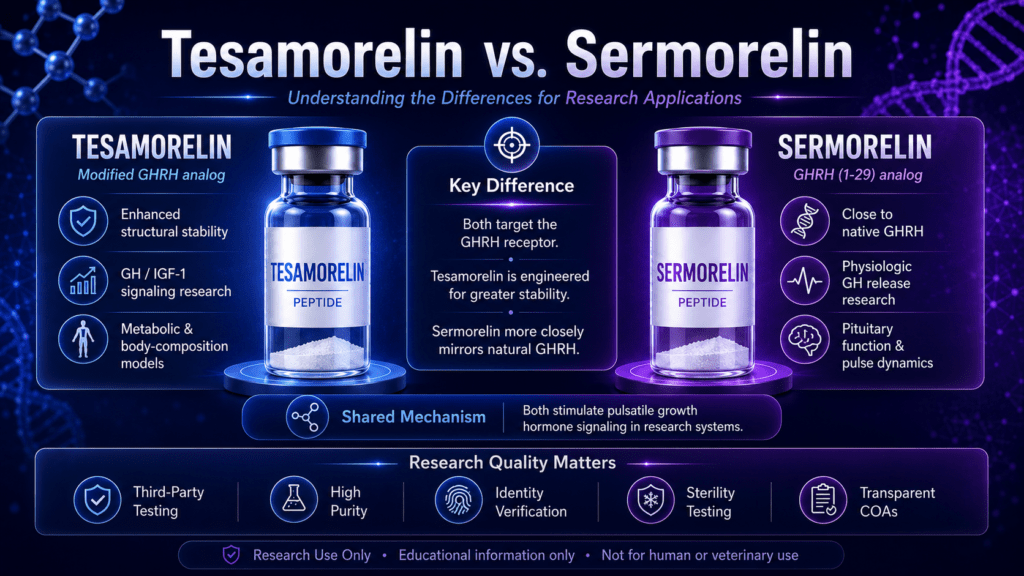
Tesamorelin vs. Sermorelin: What’s the Difference?
Tesamorelin and Sermorelin are two synthetic peptides frequently discussed within growth hormone research. While they share similarities in origin and mechanism, they differ in structure, stability, and research applications.
For laboratories and investigators, understanding these distinctions is important when selecting a peptide for experimental models focused on growth hormone signaling and related biological pathways.
What is Tesamorelin?
Tesamorelin is a synthetic analog of Growth Hormone-Releasing Hormone (GHRH). It was engineered to improve stability compared to naturally occurring GHRH while maintaining activity at the GHRH receptor.
In research settings, Tesamorelin is commonly investigated for its ability to stimulate pulsatile growth hormone release and influence downstream biomarkers such as insulin-like growth factor-1 (IGF-1).
Researchers have explored Tesamorelin in studies involving:
- Growth hormone signaling
- Endocrine pathway regulation
- Metabolic physiology
- Body composition models
- IGF-1 response evaluation
What is Sermorelin?
Sermorelin is a synthetic peptide representing the first 29 amino acids of native GHRH, often referred to as the biologically active portion of the natural hormone.
Because it closely resembles endogenous GHRH, Sermorelin has become a valuable research tool for studying normal pituitary physiology and growth hormone secretion.
Research involving Sermorelin frequently examines:
- Physiological GH release
- Pituitary responsiveness
- Endocrine regulation
- Growth hormone pulse dynamics
- Hormonal signaling pathways
Key Differences
Feature | Tesamorelin | Sermorelin |
|---|---|---|
Peptide Type | Modified GHRH analog | GHRH (1-29) analog |
Structural Modification | Yes | Minimal |
Research Focus | GH/IGF-1 signaling, metabolic models | Physiologic GH regulation and pituitary function |
Stability | Designed for increased stability | More closely resembles native GHRH |
Common Laboratory Interest | Endocrine and metabolic research | Pituitary and hormone regulation research |
Mechanism of Action in Research
Both peptides interact with GHRH receptors located on pituitary somatotroph cells.
Activation of these receptors initiates intracellular signaling that promotes pulsatile growth hormone release in experimental systems. Increased GH signaling may subsequently influence downstream pathways involving IGF-1, cellular metabolism, and endocrine regulation.
Although both compounds target the same receptor, their structural differences may produce distinct pharmacologic characteristics in laboratory investigations.
Why Researchers Compare Tesamorelin and Sermorelin
Scientists often compare these peptides to better understand how structural modifications influence:
- Receptor activation
- Peptide stability
- Hormone release dynamics
- Signal duration
- Endocrine feedback mechanisms
- Experimental reproducibility
These comparisons help researchers refine experimental design when investigating growth hormone physiology.
Choosing the Appropriate Research Peptide
The choice between Tesamorelin and Sermorelin depends largely on the objectives of the research project.
Investigators studying natural GHRH physiology may prefer Sermorelin due to its close similarity to endogenous GHRH.
Researchers evaluating modified GHRH analogs or examining metabolic and endocrine signaling often include Tesamorelin in their experimental protocols because of its enhanced structural stability.
Neither peptide should be considered universally superior; each serves different scientific purposes depending on the study design.
Research Quality Matters
Reliable laboratory outcomes begin with high-quality research materials.
Researchers should look for products that include:
- Independent third-party analytical testing
- High purity
- Identity verification
- Sterility testing, when applicable
- Transparent Certificates of Analysis (COAs)
These quality measures help improve reproducibility and confidence in experimental results.
Research Use Only Statement
The information provided is intended solely for educational and informational purposes. It is not intended as, and should not be interpreted as medical advice, healthcare guidance, diagnosis, treatment recommendations, or professional medical opinion.
Nothing contained on this website should be relied upon to diagnose, treat, cure, mitigate, or prevent any disease or medical condition. Always seek the advice of a qualified physician or other licensed healthcare professional regarding any questions you may have about a medical condition or treatment. Never disregard or delay seeking professional medical advice because of information presented on this website.
All products offered by Pureptid Wellness are sold strictly for Research Use Only (RUO). They are intended exclusively for in vitro laboratory research conducted by qualified professionals. These products are not intended for human consumption, veterinary use, clinical use, therapeutic use, cosmetic use, household use, or any other use outside legitimate laboratory research.
They are not drugs, dietary supplements, or cosmetic ingredients, and are not intended for human or veterinary use, diagnosis, treatment, cure, or prevention of any disease. Products should be handled only by qualified professionals in appropriate research environments.
Conclusion
Tesamorelin and Sermorelin are valuable tools for investigating growth hormone biology. While both interact with the GHRH receptor, their structural differences make them useful for different types of laboratory research.
Understanding these distinctions allows researchers to select the most appropriate peptide for studies involving endocrine signaling, growth hormone physiology, and related biological processes.