
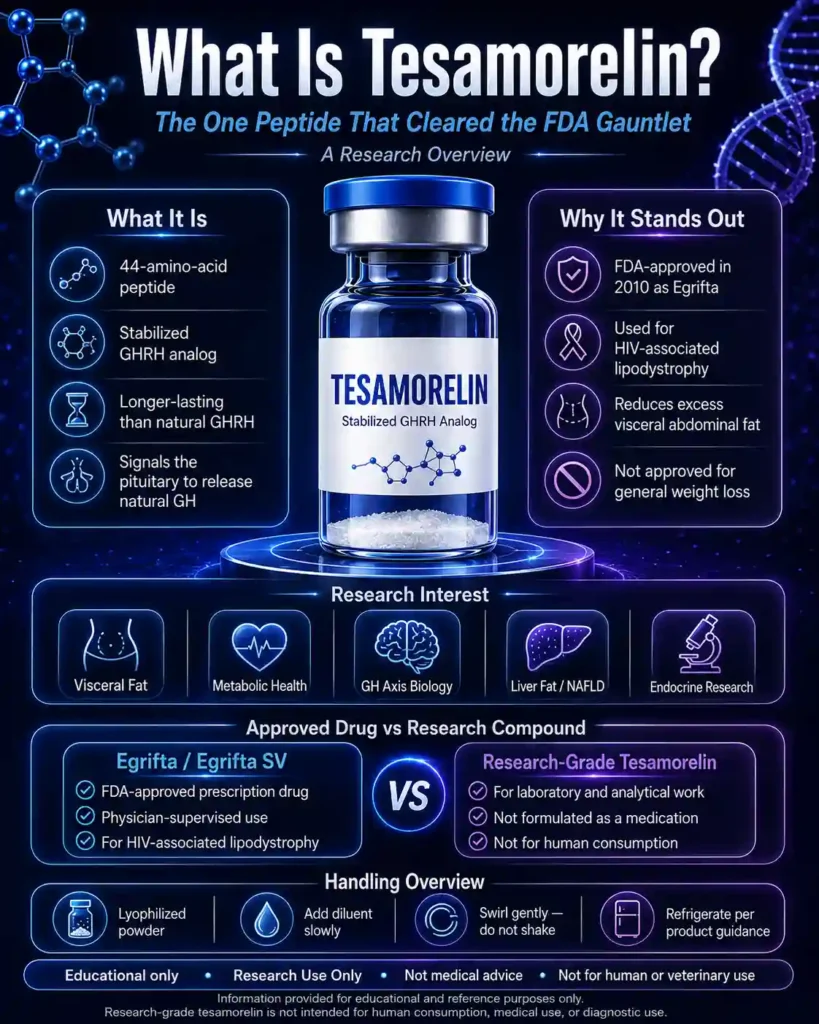
Tesamorelin: The One Peptide That Actually Made It Through the FDA Gauntlet
Here’s a fun bar trivia question for the next time you’re stuck making small talk at a networking event: name a peptide that isn’t insulin or a GLP-1 drug that’s actually, fully, no-asterisks FDA-approved.
Most people draw a blank. The internet’s current peptide obsession, BPC-157, TB-500, all those “research use only” vials with the cult-like Reddit followings, hasn’t cleared that bar. But one compound quietly did, back in 2010, and it’s been doing its job in doctors’ offices ever since with almost none of the social media fanfare. Meet tesamorelin.
Okay, So What Actually Is Tesamorelin?
Tesamorelin is a 44-amino-acid peptide, and it’s not some brand-new lab invention — it’s a stabilized, longer-lasting version of a hormone your body already makes: growth hormone-releasing hormone, or GHRH, as defined in the National Human Genome Research Institute’s genetics glossary. Your hypothalamus produces GHRH naturally to tell your pituitary gland, “hey, release some growth hormone.” Tesamorelin is engineered to do the same job, just with a small chemical modification (a hexenoyl group tacked onto one end) that keeps it from getting broken down as fast in your bloodstream. That tweak alone is the difference between a molecule that works for a few minutes and one that actually gets somewhere clinically useful.
Here’s the part that makes tesamorelin genuinely elegant, not just another injectable: it doesn’t flood your body with growth hormone directly, the way synthetic HGH does. Instead, it politely knocks on your pituitary gland’s door and asks it to do what it already knows how to do — release growth hormone in its normal, natural, pulsatile rhythm. Your body stays in the driver’s seat. Tesamorelin just reminds it to hit the gas a little more often.
The FDA Approval Story (Yes, There’s an Actual Story)
In November 2010, the FDA approved tesamorelin under the brand name Egrifta, developed by Theratechnologies, for one specific and fairly narrow purpose: reducing excess visceral abdominal fat in HIV-infected patients with lipodystrophy. If that sounds oddly specific, that’s because it is, and that specificity is exactly why it got approved. The full FDA prescribing information for Egrifta lays out exactly what it’s indicated for — and just as importantly, what it isn’t.
HIV-associated lipodystrophy is a real and often distressing condition. Certain antiretroviral therapies, while lifesaving, can cause a strange redistribution of body fat: patients lose fat in their face and limbs while gaining it around the abdomen and internal organs (the visceral kind, the metabolically troublesome kind). It’s not just a cosmetic issue — that visceral fat accumulation is tied to real cardiovascular and metabolic risk. Before tesamorelin, there was essentially no approved treatment for it.
Two Phase 3, randomized, placebo-controlled trials — the gold standard of clinical evidence — enrolled more than 800 HIV-positive adults with lipodystrophy. The results held up: tesamorelin reduced visceral adipose tissue by roughly 15% compared to placebo over 26 weeks, along with measurable reductions in waist circumference. That’s not a marketing claim pulled from an Instagram ad — that’s what got it through the FDA’s front door, the hardest door in American medicine to get through.
Worth noting, because the FDA was explicit about it: Egrifta is not approved, and is not intended, for general weight loss. It’s a weight-neutral therapy for a specific fat redistribution problem, not an Ozempic competitor. If your algorithm has been feeding you tesamorelin content next to weight-loss ads, that’s the internet doing what the internet does — mixing up “peptide that affects body composition” with “peptide for weight loss.” They’re not the same conversation.
Why Researchers Keep Circling Back to It
Here’s where tesamorelin gets genuinely interesting from a research standpoint, beyond its one narrow approved indication. Because it works through such a clean, well-understood mechanism — stimulate the pituitary, get natural pulsatile GH release, watch what happens to fat metabolism — it’s become a favorite tool for researchers studying broader questions about growth hormone, visceral fat, and metabolic health that go well beyond its original HIV-specific approval.
Ongoing academic and laboratory interest includes:
- Non-alcoholic fatty liver disease (NAFLD) research, since growth hormone appears to have protective effects on liver fat metabolism
- Visceral fat and metabolic syndrome research more broadly, outside the original HIV context
- Growth hormone axis research generally, where tesamorelin’s clean, physiological mechanism (compared to synthetic HGH’s brute-force approach) makes it a useful comparison point
None of that off-label research interest changes what’s actually approved for human medical use — that’s still narrowly Egrifta, for HIV-associated lipodystrophy, under a doctor’s prescription. But it does explain why tesamorelin shows up constantly in academic literature well outside its original approval, and why it’s one of the most-cited peptides in growth-hormone-adjacent research circles.
The Cost Reality Check
One thing that doesn’t get talked about enough: brand-name Egrifta is genuinely expensive. List price runs somewhere in the range of $24,000 to $30,000 a year, which is a big part of why compounded and research-grade versions of tesamorelin have become such a talking point online — people are looking for cheaper access to a molecule with real, documented clinical data behind it. That price tag is also exactly why the line between “FDA-approved prescription drug” and “research compound” matters so much here. They may share a molecular name, but they are not the same product, manufactured under the same oversight, or legally interchangeable.
How Reconstitution Works (General Overview)
Like most peptides, tesamorelin ships as a freeze-dried powder that needs to be reconstituted with a liquid diluent before it’s usable in a laboratory setting. The general process researchers typically follow:
- Let the vial and diluent reach room temperature before mixing.
- Wipe the vial top with an alcohol swab.
- Add the diluent slowly, letting it run down the inside of the vial rather than hitting the powder directly.
- Swirl gently — never shake — until fully dissolved.
- Store according to the specific product’s guidance, typically refrigerated.
Exact reconstitution ratios and storage windows vary by formulation and supplier, so this is a general overview only — always defer to the specific documentation provided for the exact product in question.
Research Peptide vs. Approved Drug: The Line That Actually Matters
This is the single most important thing to walk away with. Tesamorelin exists in two completely separate worlds:
- Egrifta / Egrifta SV — the FDA-approved prescription medication, manufactured by Theratechnologies, prescribed by licensed physicians specifically for HIV-associated lipodystrophy, backed by large randomized clinical trials.
- Research-grade tesamorelin — the compound studied by labs and researchers for its mechanism and broader effects, sold strictly for research, laboratory, and analytical purposes.
These are not interchangeable, and no reputable supplier will tell you otherwise. Research peptides haven’t been through the FDA’s approval process for human use, haven’t been formulated or dosed as a medication, and aren’t intended for human consumption, medical use, or diagnostic use. That’s precisely the category Pureptid Wellness supplies for — research and analytical work, not a substitute for a prescription.
Frequently Asked Questions
Is tesamorelin the same as HGH? No. HGH (human growth hormone) is the hormone itself, given directly. Tesamorelin is a GHRH analog — it stimulates your own pituitary gland to release its own growth hormone, rather than supplying growth hormone from outside.
What is tesamorelin actually approved for? Reducing excess visceral abdominal fat in HIV-infected adults with lipodystrophy, under the brand name Egrifta. It is not approved for general weight loss.
Is tesamorelin legal? As an FDA-approved medication (Egrifta), yes, when prescribed by a licensed healthcare provider. As a research compound, it’s legal to purchase for research, laboratory, and analytical purposes from suppliers who are explicit that their products are not for human consumption or medical use.
How is tesamorelin different from sermorelin? Both are GHRH analogs, but tesamorelin is the full 44-amino-acid GHRH sequence with a stabilizing modification, while sermorelin is a shorter fragment. Tesamorelin has a longer half-life and, unlike sermorelin, retains active FDA approval today.
DISCLAIMER: All information contained in the preceding article is provided solely for general informational and educational purposes. It is not medical advice and is not intended to diagnose, treat, cure, prevent, or mitigate any disease or medical condition. Nothing in this article should be interpreted as instructions for human or veterinary use, administration, dosing, or self-experimentation.
Pureptid Wellness is not a compounding pharmacy or chemical compounding facility as defined under Section 503A of the Federal Food, Drug, and Cosmetic Act, and is not an outsourcing facility as defined under Section 503B of the Federal Food, Drug, and Cosmetic Act.
FDA Disclaimer: The statements, products, and information provided on this website have not been evaluated by the US Food and Drug Administration. These statements and products are not intended to diagnose, treat, cure, or prevent any disease.
All products sold by Pureptid Wellness are intended solely for research, laboratory, or analytical purposes only. Products are not intended for human consumption, medical use, or diagnostic use. Information provided is for educational and reference purposes only.