
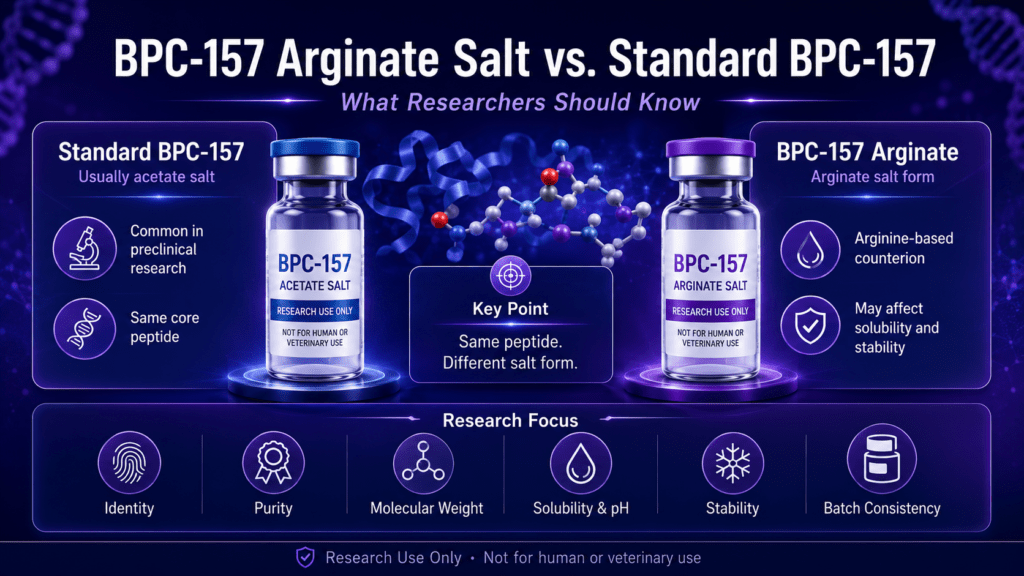
BPC-157 Arginate Salt vs. Standard BPC-157: What Researchers Should Know
BPC-157 is a synthetic 15-amino-acid peptide studied primarily in laboratory and animal models. Although BPC-157 Arginate and standard BPC-157 contain the same core peptide sequence, they differ in their associated salt form.
Standard BPC-157 is commonly supplied as the acetate salt and is the form represented in much of the published preclinical literature. BPC-157 Arginate pairs the peptide with an arginine-based counterion. This modification may influence laboratory characteristics such as solubility, pH behavior, storage stability, or resistance to degradation.
Arginate is sometimes promoted as having greater stability or bioavailability than conventional BPC-157. However, publicly available peer-reviewed research directly comparing the two forms remains extremely limited. Claims of dramatically improved absorption or biological performance have not been established through well-controlled human clinical trials and should not be presented as confirmed facts.
For laboratory researchers, the appropriate form depends on the experimental design. Important considerations include:
- Peptide identity and salt designation
- Purity and peptide content
- Molecular weight calculations
- Solubility and pH
- Storage and stability data
- Certificate of Analysis and analytical methods
- Consistency between experimental batches
The salt form should always be documented because the counterion can affect formulation properties and mass-based calculations. Researchers should avoid treating acetate and arginate materials as automatically interchangeable without analytical verification.
BPC-157, including its arginate form, is not approved by the FDA to diagnose, treat, cure, or prevent any disease. The FDA has also identified safety concerns and insufficient human safety information related to compounded BPC-157 products. (FDA safety information)
Research Use Only Disclaimer: BPC-157 and BPC-157 Arginate are intended strictly for laboratory research and analytical testing. They are not intended for human or veterinary use, consumption, clinical treatment, diagnosis, or therapeutic application. This content is provided for educational and scientific purposes only.