
Introduction
Peptide purity is a key analytical parameter in laboratory research, influencing reproducibility, interpretation of results, and experimental consistency. Two of the most commonly referenced analytical techniques for evaluating peptides are High-Performance Liquid Chromatography (HPLC) and Mass Spectrometry (MS). Although both are frequently mentioned together, they serve different analytical purposes and provide distinct types of information.
This article explains how HPLC and mass spectrometry are used in peptide analysis and how their results should be interpreted in a research context.
What Is Peptide Purity?
In analytical chemistry, peptide purity generally refers to the relative proportion of the target peptide compared to other detectable components in a sample. Purity is typically expressed as a percentage derived from analytical separation techniques rather than as an absolute measure of content.
Importantly, purity does not describe biological activity, suitability for clinical use, or safety.
HPLC: Measuring Relative Purity
High-Performance Liquid Chromatography is widely used to assess peptide purity.
How HPLC Works
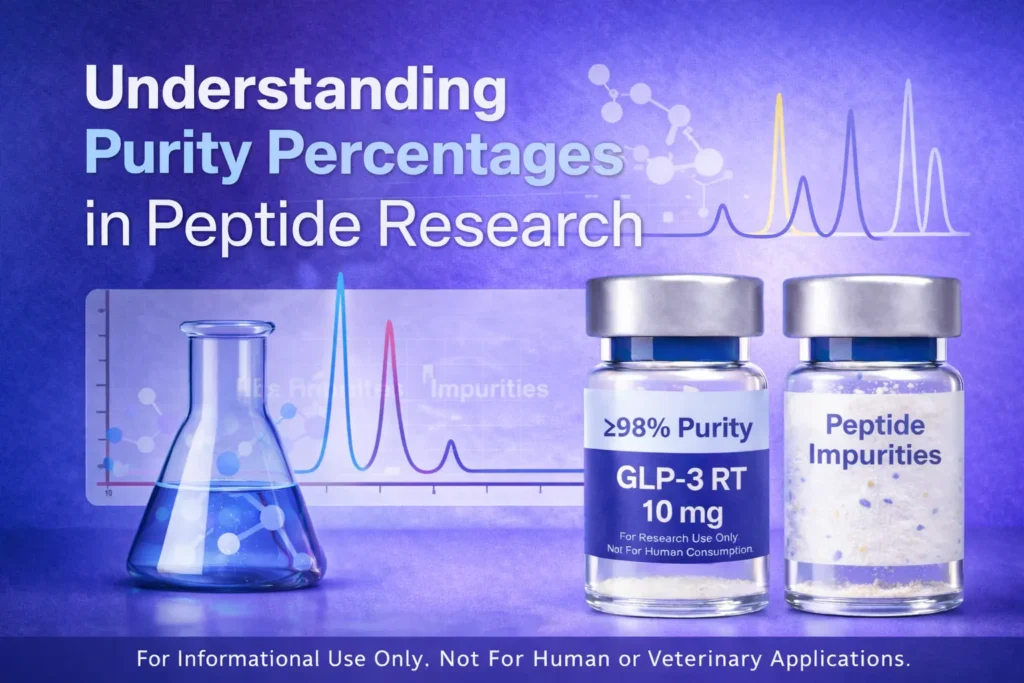
• A peptide sample is passed through a chromatographic column
• Components separate based on interactions with the stationary phase
• A detector (often UV) records distinct peaks
• The primary peak corresponds to the target peptide
• Smaller peaks represent impurities or related compounds
What HPLC Purity Represents
HPLC purity is calculated by comparing the area of the main peak to the total area of all detected peaks. This value reflects relative chromatographic purity, not absolute peptide quantity.
Mass Spectrometry: Confirming Identity
Mass spectrometry is typically used to confirm molecular weight and identity, not purity.
What MS Provides
• Observed molecular mass
• Comparison to expected molecular weight
• Detection of truncations, adducts, or modifications
Limitations of MS
Mass spectrometry does not quantify how much of a peptide is present relative to impurities and should not be used alone to claim purity percentages.
Why Both Methods Are Used Together
In research settings, HPLC and MS are often complementary:
• HPLC evaluates relative purity
• MS confirms molecular identity
Together, they provide a more complete analytical profile without implying suitability for any non-research application.
Research Context Considerations
Analytical results depend on:
• Detection methods
• Sample preparation
• Instrument settings
• Analytical thresholds
Results apply only to the specific sample tested.
Disclaimer
This article is provided for informational and research reference purposes only. It does not constitute medical, clinical, or regulatory guidance. All materials referenced are intended for laboratory research use only, and are not intended for human or veterinary applications.