
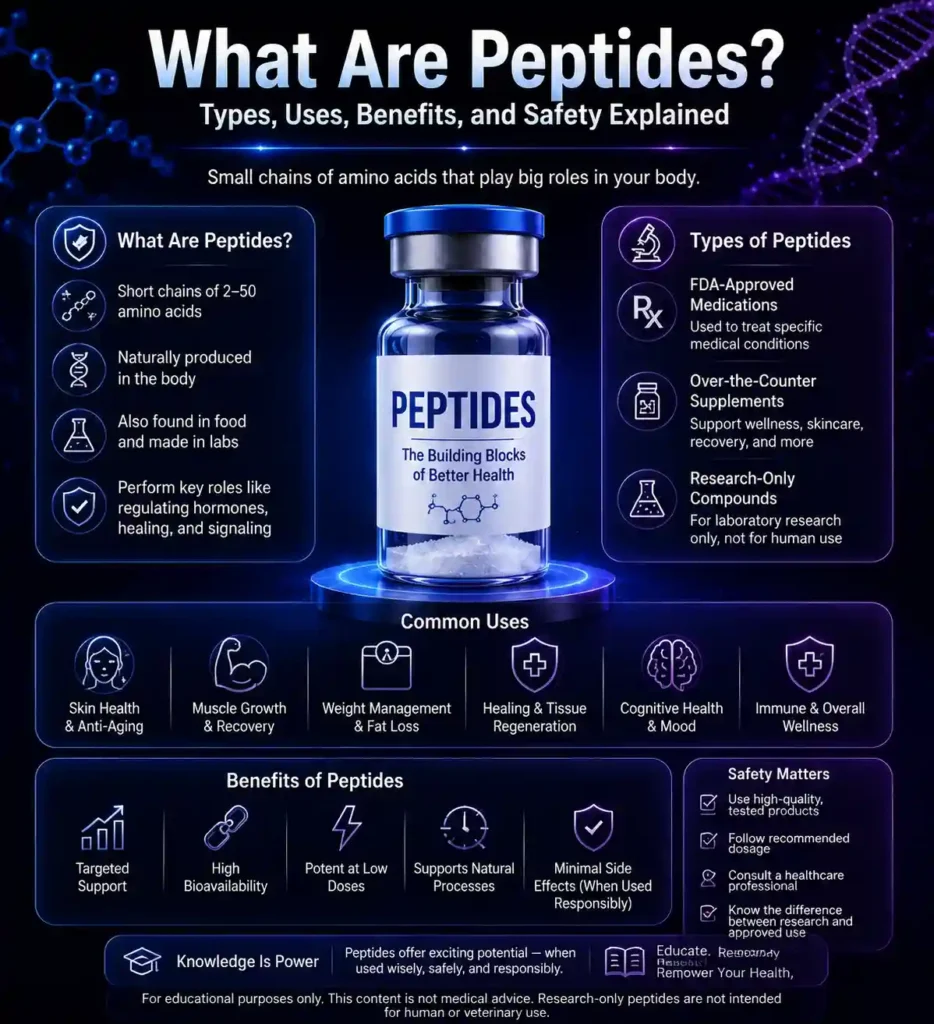
What Are Peptides? Types, Uses, Benefits, and Safety Explained
Peptides are everywhere in health conversations right now, from skincare aisles to weight-loss clinics to social media ads promising faster muscle recovery. But despite how often the word gets thrown around, most people couldn’t actually define what a peptide is if you asked them on the spot.
Here’s the full picture: what peptides are, how they work in the body, the different categories peptides fall into (FDA-approved medications, over-the-counter supplements, and research-only compounds), what the evidence says about safety, and where research peptides, the kind we work with at Pureptid Wellness, actually fit into that landscape.
What Are Peptides?
Peptides are short chains of amino acids — the same “building block” molecules that make up proteins — typically ranging from 2 to 50 amino acids long, according to the National Human Genome Research Institute’s genetics glossary. Amino acids link together through bonds called peptide bonds, and depending on the sequence and length of that chain, the resulting molecule can do everything from regulating blood sugar to healing a wound to telling a gland when to release a hormone.
Your body makes peptides constantly and naturally. You don’t need to take a supplement for peptides to exist inside you — they’re already doing quiet, essential work in your bloodstream right now. Some well-known examples include:
- Insulin, a 51-amino-acid peptide hormone that helps your cells absorb sugar from food
- Endorphins, released by your central nervous system to block pain and reduce stress
- Growth hormone-releasing hormone (GHRH), which signals your pituitary gland to produce growth hormone
Beyond what your body makes on its own, peptides can also come from dietary protein sources (meat, eggs, dairy, legumes, and other high-protein foods) or be manufactured in a lab. Lab-made, or synthetic, peptides are what you’ll find in medications, dietary supplements, and skincare products.
Interestingly, peptide-based medicine isn’t new. Researchers have been developing peptides as treatments since the early 1920s — insulin was the very first synthetic peptide, first used to treat type 1 diabetes back in 1923.
Peptides vs. Proteins: What’s the Difference?
Peptides and proteins are built from the same raw material — amino acids linked by peptide bonds — so the confusion is understandable. The distinction mostly comes down to length and structure:
- Peptides are shorter chains, generally under 50 amino acids (though the exact cutoff varies by source).
- Proteins are longer, more complex chains — most scientists draw the line somewhere around 100+ amino acids — that fold into specific three-dimensional shapes.
Within the peptide category, scientists get even more specific: chains of roughly 10–20 amino acids are sometimes called oligopeptides, and anything longer than 20 (but still short of protein territory) is called a polypeptide.
Because peptides are smaller, they tend to be easier for the body to absorb, easier to synthesize in a lab, and easier to target for a specific biological effect — which is a big part of why peptide-based drug development has expanded so quickly.
What Are Peptides Used For?
Peptides are studied and used across a genuinely wide range of applications — some backed by decades of rigorous clinical research, others still very much in the “promising but unproven” category. Here’s the breakdown by use case.
Peptides for Skin and Anti-Aging
This is probably the most mainstream use of peptides, and it starts with collagen. Collagen is the structural protein behind your skin, muscles, bones, and connective tissue — it’s what keeps everything firm and elastic. As you age, your body produces less of it and breaks down what you have more quickly, which is a major driver of wrinkles, sagging skin, and weaker joints.
Because your body can’t absorb whole collagen, supplement makers break it down into smaller collagen peptides (also called hydrolyzed collagen) that are easier to digest. Research on oral collagen peptide supplements suggests they may help improve skin moisture and elasticity, particularly in adults over 30, and may also ease joint pain in people with osteoarthritis.
Two other peptides frequently found in anti-aging skincare:
- Copper peptide (GHK-Cu) — studied for its potential to support collagen and elastin production, reduce fine lines and hyperpigmentation, and improve skin moisture and thickness. Note: injectable copper peptide products were pulled from the market by the FDA in 2023 after reports of impurities triggering immune reactions — the topical versions found in creams and serums are a separate category.
- Palmitoyl pentapeptide-4 (Matrixyl) — a synthetic peptide studied for its potential to boost collagen production and improve skin texture.
Your skin also naturally produces antimicrobial peptides (AMPs), which help fight bacteria, support wound healing, and maintain a healthy skin barrier. Imbalances in AMP production have been linked to conditions like psoriasis, eczema, rosacea, and acne, which is why some prescription treatments for these conditions are built around peptide technology.
Peptides for Muscle Growth and Recovery
Some research suggests that combining peptide supplementation (particularly collagen and creatine peptides) with resistance training may support greater gains in muscle strength and mass compared to exercise alone. The theory is that peptides may support faster tissue repair after training stress.
There’s also a category called growth hormone secretagogues (GHS) — synthetic peptides thought to stimulate the body’s own growth hormone production. These are a genuine gray area: some are marketed for muscle-building and recovery, but they’re not universally regulated, may reduce insulin sensitivity, and are banned by the World Anti-Doping Agency for competitive athletes.
Peptides for Weight Loss
This is where peptides went fully mainstream. GLP-1 receptor agonists — semaglutide (marketed as Ozempic and Wegovy) and tirzepatide (Zepbound and Mounjaro) — are peptide-based medications originally developed for type 2 diabetes that have since become some of the most talked-about weight-loss drugs in modern medicine. These are FDA-approved, prescription-only, and backed by large-scale clinical trials.
Peptides for Bone Health
A handful of studies have looked at whether collagen peptide supplementation can support bone mineral density, particularly in postmenopausal women — a group especially prone to bone loss. Results have generally pointed toward modest improvements with consistent, long-term use, though researchers are careful to note this isn’t a replacement for medical treatment of osteoporosis. Separately, there are FDA-approved peptide drugs specifically indicated for osteoporosis (more on those below).
Peptides for Hair Growth
Copper peptides (GHK-Cu) show up again here — some research points to a potential role in stimulating hair growth, particularly for pattern hair loss, when applied as a topical scalp serum.
Peptides for Hormone and Testosterone Support
Certain peptides are studied for their potential to stimulate hormones involved in testosterone production — specifically gonadotropin-releasing hormone (GnRH), luteinizing hormone (LH), and follicle-stimulating hormone (FSH). Two frequently referenced compounds are kisspeptin-10 and gonadorelin, both studied for their effects on testosterone levels in small clinical trials.
Peptides for Wound Healing and Immune Function
Beyond skin applications, peptides are a genuinely active area of infection and wound-care research. Antimicrobial peptides are being studied as a potential alternative to traditional antibiotics — especially relevant given rising antibiotic resistance — and other peptides are being explored for their potential to help chronic wounds, like diabetic foot ulcers, heal more effectively.
Peptide Therapy: How Are Peptides Administered?
“Peptide therapy” refers to the use of peptides — whether naturally derived or synthetic — to influence a specific bodily function. Depending on the peptide and its intended use, administration can take a few different forms:
- Oral — pills or powders, most common for dietary supplements
- Topical or transdermal — creams, serums, and patches, common in skincare
- Nasal — sprays, used for select applications
- Injection — the most common route for prescription peptide therapy, since injecting directly into the bloodstream avoids the breakdown that happens during digestion
The delivery method matters more than people expect. Many peptides are structurally fragile and simply don’t survive digestion or absorption through skin very well, which is exactly why injectable forms are so common in clinical and prescription settings — it’s often the only route that gets a meaningful, intact dose where it needs to go.
FDA-Approved Peptide Drugs
It’s worth separating fact from marketing noise here: more than 100 peptide drugs are currently FDA-approved for use in the United States, a number that continues to climb as peptide-based drug development expands across therapeutic areas — see, for example, this peer-reviewed review of FDA-approved peptide-based antimicrobials published via the National Center for Biotechnology Information. These aren’t experimental — they’ve gone through the same rigorous clinical trial process as any other prescription medication. Examples include:
- Semaglutide (Ozempic, Wegovy), tirzepatide (Zepbound, Mounjaro), dulaglutide (Trulicity), liraglutide (Victoza), and lixisenatide (Adlyxin) — for type 2 diabetes and/or obesity
- Insulin — for blood sugar regulation in diabetes
- Abaloparatide (Tymlos) and teriparatide (Forteo) — for osteoporosis
- Enfuvirtide (Fuzeon) — for HIV
- Linaclotide (Linzess) — for IBS with constipation
- Ziconotide (Prialt) — for severe chronic pain
- Degarelix (Firmagon) — for advanced prostate cancer
- Carfilzomib (Kyprolis) — for multiple myeloma
These medications are prescribed and monitored by licensed healthcare providers, and their safety profiles have been established through years of clinical data. If you’re considering a peptide-based medication for a specific health condition, that conversation belongs with your doctor.
It’s worth pausing here on an important distinction, because this list is where a lot of confusion starts. The drugs above went through the full FDA approval pipeline as finished pharmaceutical products. That is a completely separate category from research peptides — the unformulated compounds studied in laboratory settings before (and sometimes long before) anything resembling drug development happens. Research peptides are not consumer medications, and they are not sold as one. They’re a tool used earlier in the pipeline: in vitro studies, analytical work, and early-stage research into how a given peptide sequence behaves. Where Pureptid Wellness sits is squarely in that research category — supplying compounds for lab, analytical, and research use only, not for human consumption or medical use.
Peptide Supplements and Peptides in Food
Separate from prescription peptide drugs, you’ll also find peptides sold as over-the-counter dietary supplements — usually collagen, creatine, or follistatin peptides marketed for muscle building, recovery, skin, or joint health. These products are not regulated by the FDA the same way medications are, meaning manufacturers aren’t required to prove their claims before putting a product on the shelf.
Peptides also occur naturally in many everyday foods, particularly protein-rich ones:
- Meat, fish, and shellfish
- Eggs and dairy
- Beans and lentils
- Soy
- Oats
- Flaxseed and hemp seeds
- Wheat
If your diet already includes a good mix of these, your body is getting a steady, natural supply of peptides without any supplement involved.
Are Peptides Safe? Side Effects and Risks
This is where the FDA-approved and non-approved categories really diverge, and it’s the single most important distinction in this whole topic.
FDA-approved peptide medications have been through large-scale clinical trials, meaning there’s solid data on their safety and side-effect profiles when used under medical supervision. That doesn’t mean zero risk — like any medication, they carry documented, monitored side effects — but the risk profile is well understood.
Peptide supplements and unregulated injectable peptides are a different story. For generally healthy people, peptide supplements derived from food sources aren’t likely to cause serious issues, since they’re similar to what you’d absorb from eating protein-rich meals anyway. But because the FDA doesn’t vet supplements before they hit the market, quality and purity can vary a lot between brands.
The bigger concern is the fast-growing market of injectable research peptides — compounds like BPC-157, GHK-Cu injections, and TB-500 that circulate through online storefronts and some wellness clinics, often labeled “for research purposes only” despite being marketed for personal use. These products exist in a regulatory gray zone: they haven’t gone through FDA safety review, sourcing and manufacturing conditions vary widely (and are sometimes based overseas with little oversight), and there have been documented cases of impurities and contamination. Because of that, some injectable peptides have been associated with abnormal immune responses, including allergic reactions and, in rare cases, more serious autoimmune concerns.
Possible side effects reported with peptide use, particularly unregulated injectable forms, include:
- Allergic reactions — hives, swelling, or in severe cases, difficulty breathing
- Gastrointestinal issues — nausea, vomiting, diarrhea
- Cardiovascular effects — elevated blood pressure, rapid heart rate, palpitations
- Headache, dizziness, or fatigue
- Injection-site irritation
- Skin sensitivity or rash (for topical peptides)
People who are pregnant, nursing, managing a medical condition, or taking other medications should talk to a healthcare provider before using any peptide product — supplement, topical, or otherwise.
Are Peptides Legal?
The honest, direct answer: it depends entirely on which peptide and how it’s being used.
- Peptide medications that have gone through FDA approval (like the GLP-1 drugs and the others listed above) are fully legal when prescribed and administered by a licensed healthcare provider.
- Peptides sold as food-derived dietary supplements are legal to sell and purchase, though — again — they’re not FDA-vetted for effectiveness before hitting shelves.
- Peptides sold specifically for research, laboratory, or analytical purposes exist in a different category entirely. Legitimate suppliers in this space are explicit that these products are not intended for human consumption, medical use, or diagnostic use, and are not sold by compounding pharmacies or outsourcing facilities as defined under Sections 503A and 503B of the Federal Food, Drug, and Cosmetic Act, which the FDA outlines in detail.
Athletes should also note that most peptides, along with all anabolic steroids, are banned by the World Anti-Doping Agency for competitive sport, regardless of their legal status for general purchase.
Where Research Peptides Fit Into the Picture
Given how much noise there is around peptides right now, it’s worth being precise about where a research-only supplier fits into everything covered above.
Research peptides are the raw compounds scientists and labs use to study a sequence’s behavior — how it interacts with a receptor, how stable it is under different conditions, what it might reveal about a biological pathway. That work is often the earliest step toward eventually understanding whether a peptide has any therapeutic potential at all. Some of today’s FDA-approved peptide drugs started exactly there, years or decades before they ever reached a pharmacy shelf.
What research peptides are not is a shortcut to a prescription drug’s benefits. A research-grade compound hasn’t been through clinical trials, hasn’t been formulated or dosed for human use, and hasn’t been evaluated by the FDA for safety or effectiveness in people. That’s precisely why reputable suppliers, Pureptid Wellness included, are explicit that these products are sold strictly for research, laboratory, and analytical purposes — not for human consumption, medical use, or diagnostic use.
If your interest in peptides is scientific or research-based — studying a compound’s properties, supporting lab work, or exploring a research question — that’s exactly the lane research peptides are built for. If your interest is a specific health outcome for yourself, the right starting point is a licensed healthcare provider and, where applicable, an FDA-approved medication.
Frequently Asked Questions
Are peptides the same as proteins? Not quite. Peptides are shorter amino acid chains, generally under 50 units; proteins are longer, folded structures, typically over 100 amino acids. They’re related, but not interchangeable terms.
Are peptides steroids? No. Peptides are chains of amino acids; anabolic steroids are synthetic versions of hormones like testosterone, with an entirely different chemical structure. Both are sometimes used for performance or muscle-building purposes, but they work through different mechanisms, and steroids carry a very different (and generally more severe) side-effect profile. Steroids are also more tightly controlled as regulated substances, while peptides — outside of FDA-approved drugs — tend to be more loosely regulated.
Is Ozempic a peptide? Yes. Semaglutide, the active ingredient in Ozempic and Wegovy, is a peptide-based compound that received full FDA approval after extensive clinical trials.
What are the side effects of peptides? It depends heavily on the specific peptide and how it’s administered. FDA-approved peptide drugs come with well-documented, monitored side effects. Peptide supplements are generally considered low-risk for healthy adults. Unregulated injectable peptides carry more uncertainty, including potential allergic and immune reactions.
Do I need a peptide supplement if I eat a balanced diet? Not necessarily. Peptides occur naturally in protein-rich foods, so a balanced diet already provides your body with a steady peptide supply without any additional supplementation.
The Bottom Line
Peptides are short amino acid chains that play an enormous role in how your body functions — from regulating blood sugar to healing wounds to sending hormone signals. Some peptide-based medications, like insulin and the GLP-1 drugs behind the weight-loss boom, are among the most well-studied, FDA-approved treatments in modern medicine. Others — particularly the injectable peptides trending on social media for muscle growth, anti-aging, or performance — exist in a much murkier, less-regulated space where the evidence hasn’t caught up to the hype. And separate from both of those categories sits research-grade peptides: compounds studied in labs, not sold as treatments, and not intended for anyone’s body but a petri dish or an assay.
The practical takeaway: if a peptide product is being marketed for a specific health outcome, ask where it falls on that spectrum before you use it, and loop in a healthcare provider if you’re unsure. Not every peptide claim is nonsense — but not every claim is proven, either. And if what you’re after is genuinely research-focused, that’s exactly the category Pureptid Wellness supplies for.
DISCLAIMER:
All information contained in the preceding article is provided solely for general informational and educational purposes. It is not medical advice and is not intended to diagnose, treat, cure, prevent, or mitigate any disease or medical condition. Nothing in this article should be interpreted as instructions for human or veterinary use, administration, dosing, or self-experimentation.
Pureptid Wellness is not a compounding pharmacy or chemical compounding facility as defined under Section 503A of the Federal Food, Drug, and Cosmetic Act, and is not an outsourcing facility as defined under Section 503B of the Federal Food, Drug, and Cosmetic Act.
FDA Disclaimer: The statements, products, and information provided on this website have not been evaluated by the US Food and Drug Administration. These statements and products are not intended to diagnose, treat, cure, or prevent any disease.
All products sold by Pureptid Wellness are intended solely for research, laboratory, or analytical purposes only. Products are not intended for human consumption, medical use, or diagnostic use. Information provided is for educational and reference purposes only.